The Lebanon Chapter of the Project Management Institute
Follow the Chapter
Leadership

The Psychology of Stakeholder Influence and Engagement

Insights from PMI Mumbai Chapter’s Chapter Exchange program

  • Date March 20, 2026
  • Host PMI Mumbai Chapter, Chapter Exchange
  • Format Online panel
  • PDUs 1.5
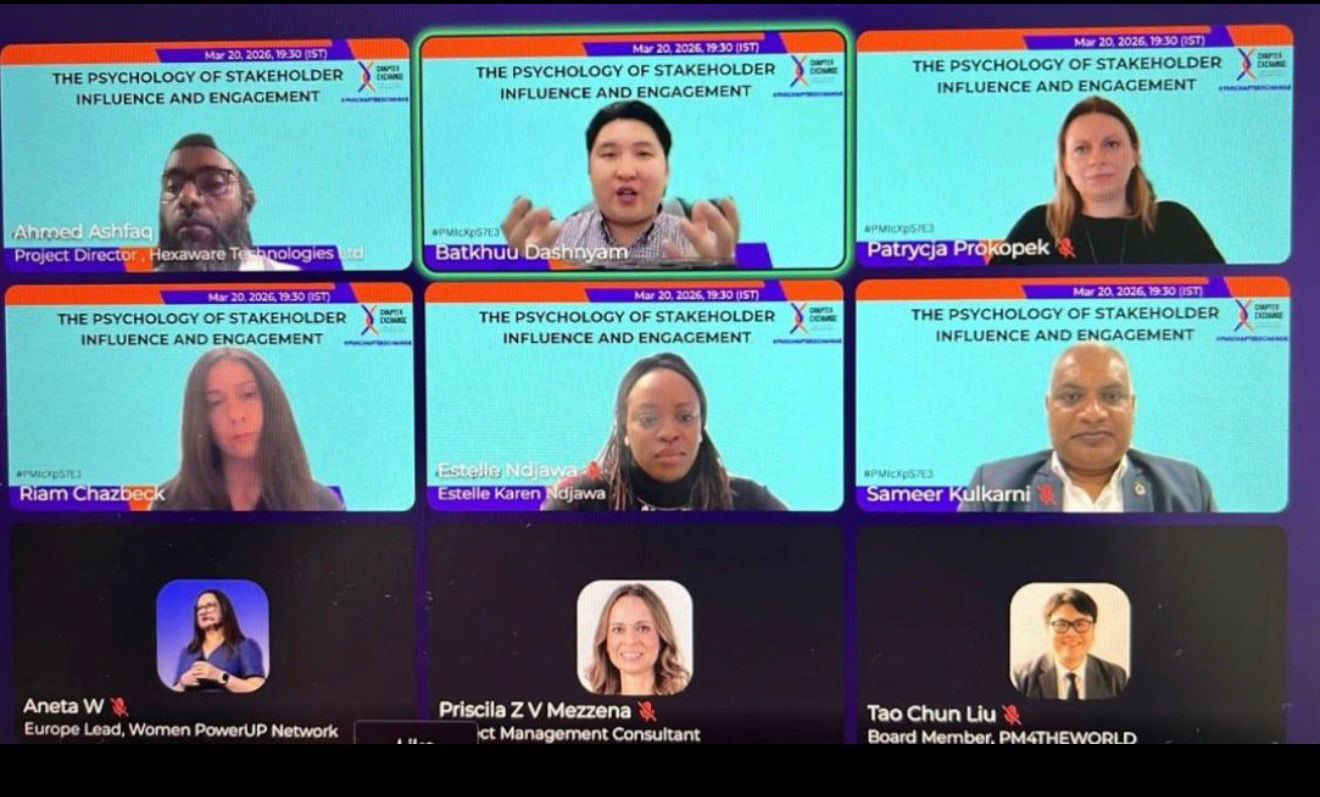
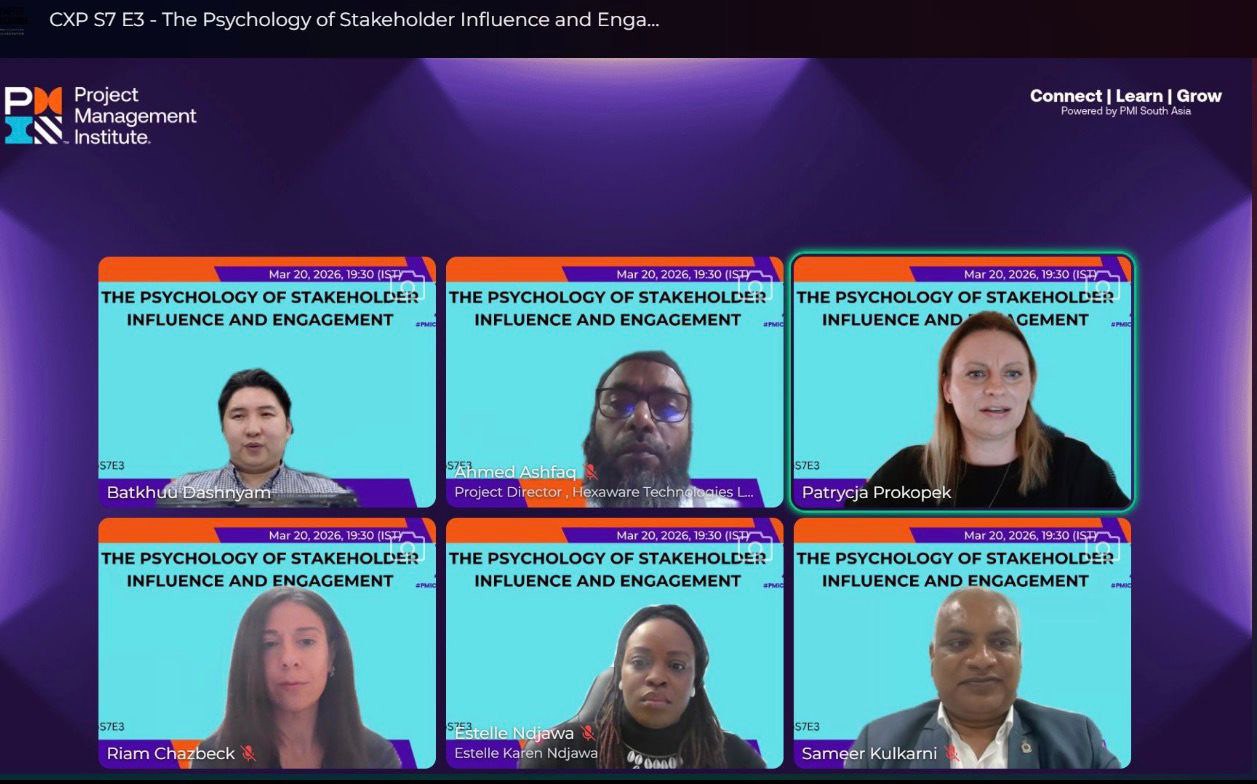
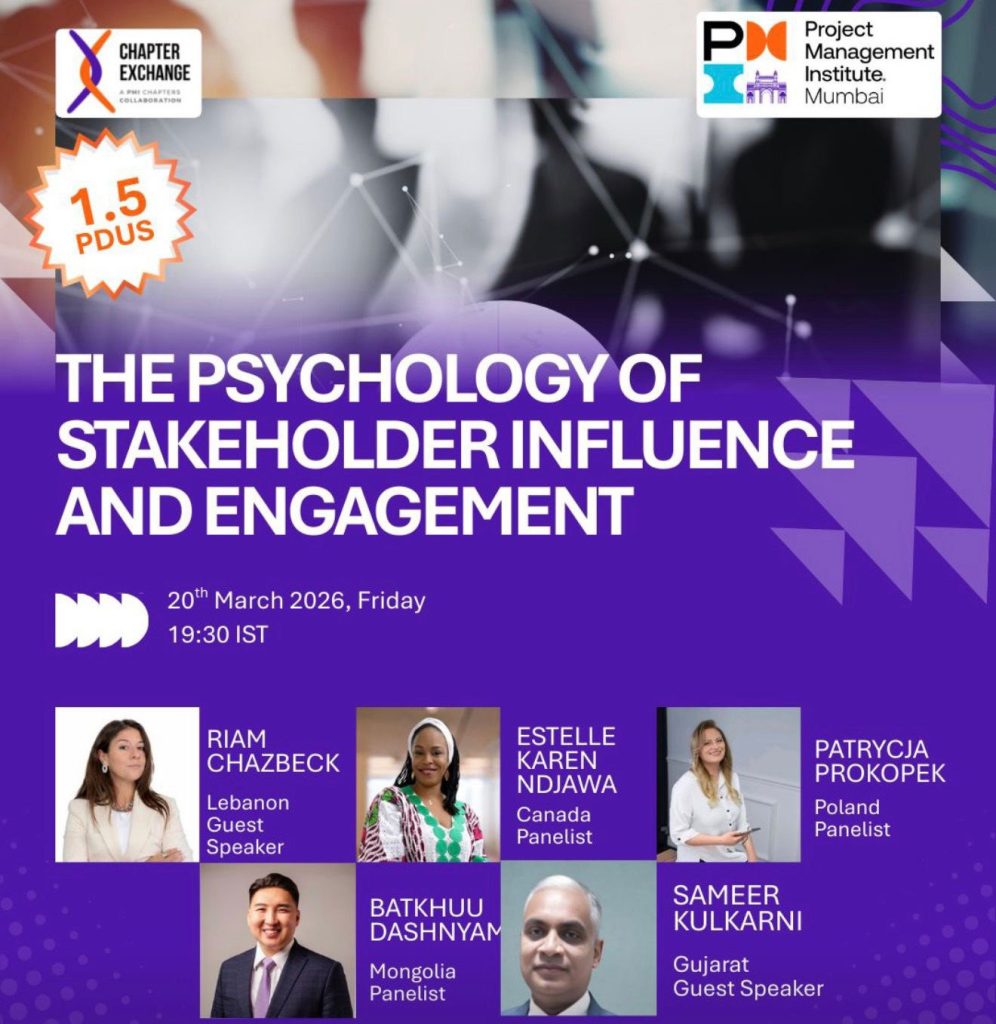
Poster: The Psychology of Stakeholder Influence and Engagement, PMI Mumbai Chapter Exchange, March 20, 2026, with Riam Chazbeck
  • Leadership
  • PMI Lebanon Chapter

“People do not resist change; resistance emerges when involvement is absent.”

On March 20, 2026, the PMI Mumbai Chapter hosted a session of its Chapter Exchange program that brought together a diverse panel of global practitioners, with PMI Lebanon Chapter President Riam Chazbeck as a guest speaker, to explore one of the most critical dimensions of project success: the human side of stakeholder engagement.

The panel featured Sameer Kulkarni, Batkhuu Dashnyam, Estelle Karen Ndjawa, Patrycja Prokopek, Ashfaq Ahmed, Tao Chun Liu, Priscila Vendramini Mezzena, and Aneta Wereszczak, each bringing perspectives shaped by international experience. At the heart of the discussion stood a powerful reminder: project management is not only about processes, tools, or timelines. It is fundamentally about people.

Moving Beyond Compliance Toward Alignment

Workplaces often seek compliance through pressure, overlooking the deeper value of alignment built through understanding. Communication tends to focus on being heard rather than truly listening, which leads to resistance, disengagement, and misalignment. When stakeholders feel heard, included, and acknowledged as part of the solution, resistance fades and ownership develops.

Key Insights From the Panel

  1. From threat to reward: stakeholder behavior is strongly shaped by emotional responses. The SCARF model (Status, Certainty, Autonomy, Relatedness, and Fairness) offers a practical lens to shift interactions from defensive reactions to collaborative engagement.
  2. Building a circle of safety: consistency and competence are the foundation of trust. In fast-paced, AI-driven environments, psychological safety encourages cooperation rather than competition.
  3. Co-creation over command: top-down directives often trigger resistance. Co-creation fosters ownership by letting stakeholders contribute meaningfully to solutions.
  4. The power of framing: how a message is delivered shapes how it is perceived. Strategic framing and early alignment conversations can do more than long presentations or data-heavy discussions.
  5. Emotional intelligence as a differentiator: technical expertise alone is no longer enough. Emotional intelligence enables deeper connection, stronger collaboration, and sustained engagement.
  6. The human anchor in project management: project professionals increasingly work where strategy meets psychology. Understanding cognitive biases, such as loss aversion and confirmation bias, supports better decisions and stakeholder alignment.

The T.R.U.S.T. Framework for Stakeholder Engagement

  • Trust: maintain consistency and transparency
  • Reward: create environments where stakeholders feel safe and valued
  • Understand: recognize underlying motivations and biases
  • SCARF: address fundamental social needs
  • Tailor: adapt communication styles to different audiences

A Call for Authentic Leadership

A recurring theme was the need to move beyond performative leadership. Authentic engagement means recognizing the human dimension in every interaction, with empathy, inclusion, and meaningful dialogue. In a complex, fast-changing professional landscape, sustainable project success depends not only on excellent execution but on the ability to genuinely engage people: successful projects are delivered by understanding and connecting with the people behind the tasks.

Recap

Key takeaways

  • Stakeholder behavior is shaped by emotions: the SCARF model shifts interactions from threat to reward.
  • Consistency and competence build trust and psychological safety.
  • Co-creation builds more ownership than top-down directives.
  • Framing and early alignment conversations shape how a message is received.
  • Emotional intelligence is now a core differentiator for project professionals.
  • Understanding cognitive biases supports better decisions and stakeholder alignment.

Key themes

  • SCARF model
  • T.R.U.S.T. framework
  • Psychological safety
  • Co-creation
  • Emotional intelligence
About the people

Meet the people in this story

ShowHide people (5)

Mr. Sameer Kulkarni

MD & CEO at Ashwini Systech

Sameer Kulkarni is MD & CEO at Ashwini Systech, delivering advisory and implementation capabilities in open-source technology, cybersecurity governance, privacy compliance, and emerging technology adoption.

Kulkarni also serves as an independent, non-executive Public Interest Director at India International Clearing Corporation, with a technology governance mandate. Earlier experience includes technology governance and digital transformation in financial analytics, alongside 27 years governing technology, communication infrastructure, and digital systems in the IAF.

Areas of expertise include cyber resilience, AI risk, governance, risk management and compliance, data sovereignty, and workforce development. Kulkarni holds a Master of Technology - MTech in Technology Management from Defence Institute of Advanced Technology (DIAT), DU, DRDO, and a BE in Electronics and Telecommunications from Amravati University.

Certifications include Certified Professional in Anti-Money Laundering and Certified Chief Information Security Officer, both from FCRF Academy. Professional contributions include serving as Industry Liaison Chair of IEEE Gujarat Section and supporting structured e-waste disposal as a sustainability ambassador through PMI Gujarat Chapter’s MakeADifference initiative.

Connect on LinkedIn ↗ with Mr. Sameer Kulkarni (opens in a new tab)

Mr. Batkhuu Dashnyam, MPA

Deputy Chief Executive Officer at Full-time

Batkhuu Dashnyam serves as Deputy Chief Executive Officer and also holds a current role as Head of Business Development. Dashnyam previously worked as Business Development Manager and has experience across the airline industry, IT, program and project management, operations, logistics, and production management.

Business development responsibilities include managing international stakeholders, key accounts, and SMEs; creating business plans; developing business cases for potential opportunities; providing consultative support; and managing projects for IT solutions. Areas of expertise include team management, technical support, leadership, communication, marketing, and client relationship management.

Dashnyam holds a Master of Public Administration - MPA in Government Administration from the National Academy of Governance and a Bachelor of Arts in Sociology from Western Washington University. Google credentials include Project Initiation: Starting a Successful Project and Capstone: Applying Project Management in the Real World.

Professional volunteering includes serving as Marketing Director at PMI Mongolia Chapter and Board Member at Mongolian Association of State Alumni (MASA).

Connect on LinkedIn ↗ with Mr. Batkhuu Dashnyam, MPA (opens in a new tab)

Ms. Estelle NDJAWA

Project Management Specialist - CEO Office

Estelle NDJAWA presents a professional focus as a “Human Project Manager,” combining bilingual English/French program and project management with human-centered governance, PMO practices, and community empowerment.

Estelle NDJAWA reports 10 years of experience across industrial, financial, entrepreneurial, and community sectors, including streamlining operations for over five companies, leading multiregional organizational and digital transformations, and overseeing project portfolios exceeding $2M.

Earlier roles include Project Management Specialist - CEO Office, Project Specialist - Planner, Chief Transformation Officer _ Maghreb, West & Central Africa, and WECA Project & Organization Manager. Areas of expertise include strategic translation, governance standards and dashboards, stakeholder engagement, cross-functional team leadership, adaptive change management, and entrepreneurial ecosystem support.

Estelle NDJAWA holds a Master 2 in Gestion de Projets and a Licence Professionnelle in Gestion de projets from CESAG, along with the Project Management Professional (PMP)® certification. Contributions beyond professional roles support ecosystems for women, emerging professionals, and entrepreneurs.

Connect on LinkedIn ↗ with Ms. Estelle NDJAWA (opens in a new tab)

Ms. Patrycja Prokopek

Engagement Manager | Senior Project Manager at Capgemini

Patrycja Prokopek is Engagement Manager | Senior Project Manager at Capgemini. Earlier experience includes serving as IT Project Manager | Transition Manager at EY, overseeing IT solutions within the Tax Portfolio for multinational businesses, including information security projects.

At IBM, Prokopek progressed from Project Coordinator to leading teams and managing international projects. Areas of expertise include strategic project management, cross-functional team leadership, change management, process optimization, business intelligence, coaching, mentoring, and talent development.

Prokopek holds a master's degree in Management from Wrocław University of Science and Technology and a bachelor's degree in Business Management & Marketing from Wyższa Szkoła Zarządzania i Finansów we Wrocławiu. Listed certifications include Elephant AI PRO for Manager and SAFe 6 Scrum Master, with the latter recorded as expired in August 2025.

Prokopek serves as PMI PC Audit Committee Member at Project Management Institute Poland Chapter and previously served as PMI PC - Wrocław Branch Leader.

Connect on LinkedIn ↗ with Ms. Patrycja Prokopek (opens in a new tab)
1 / 2Use left and right arrow keys to navigate photos.

More Chapter news

All Chapter news →

Words from the Board

Building Connections, Creating Opportunities

Vice President of Outreach Sally Zaatari shares her journey from education to project management and her vision for partnerships, shared learning and community impact.