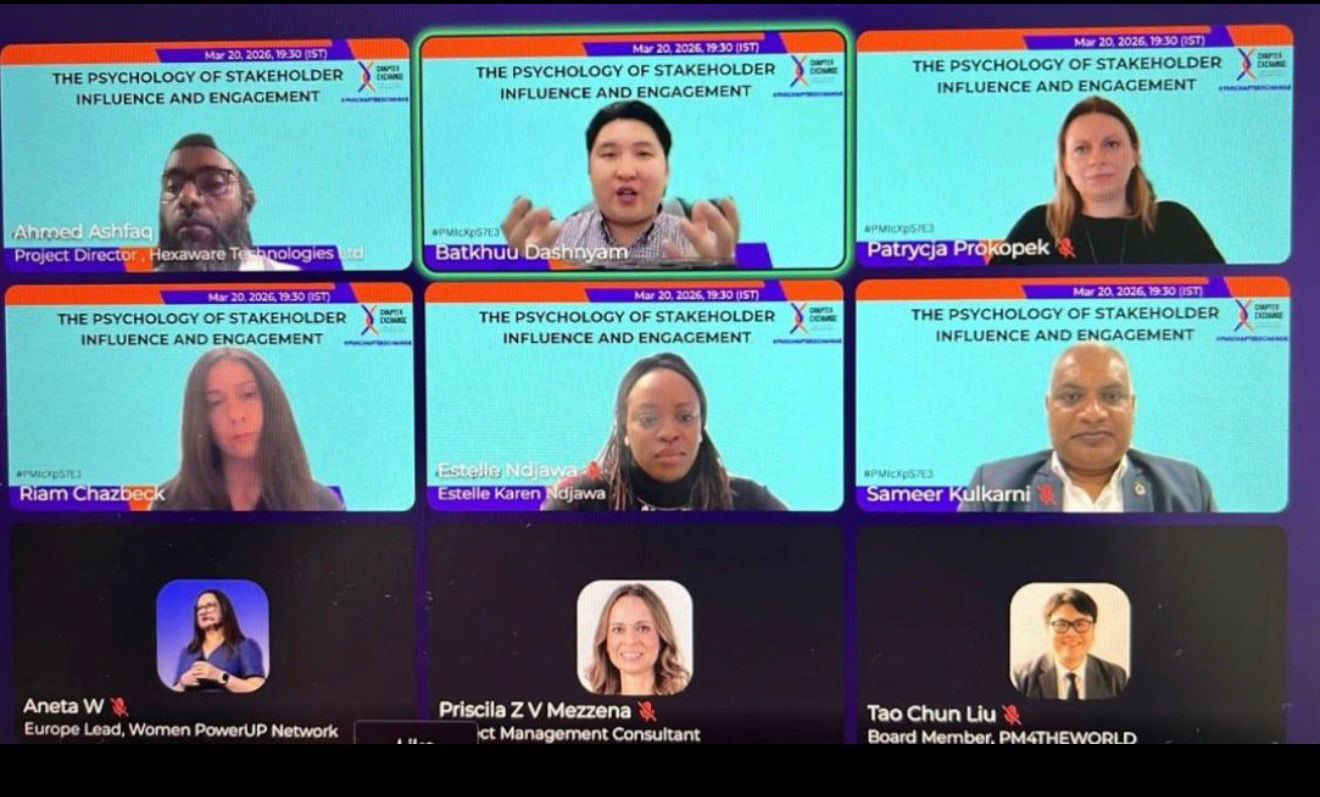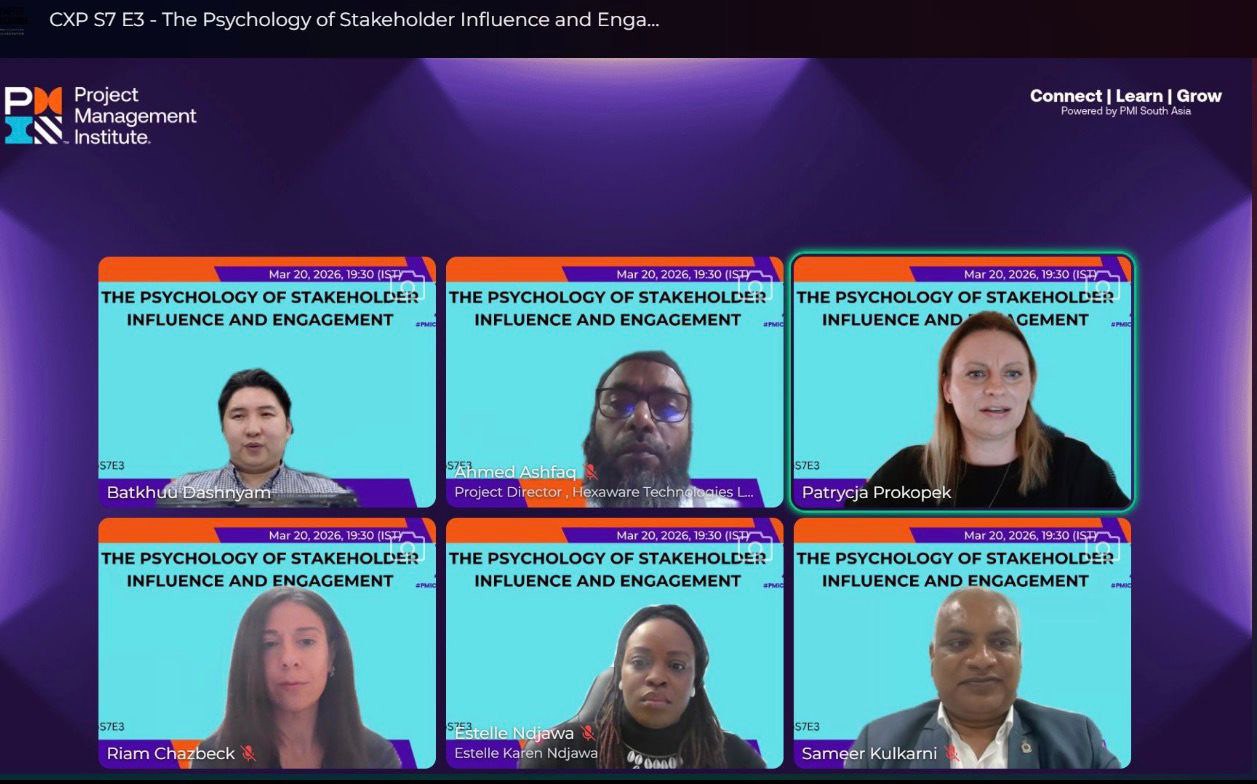
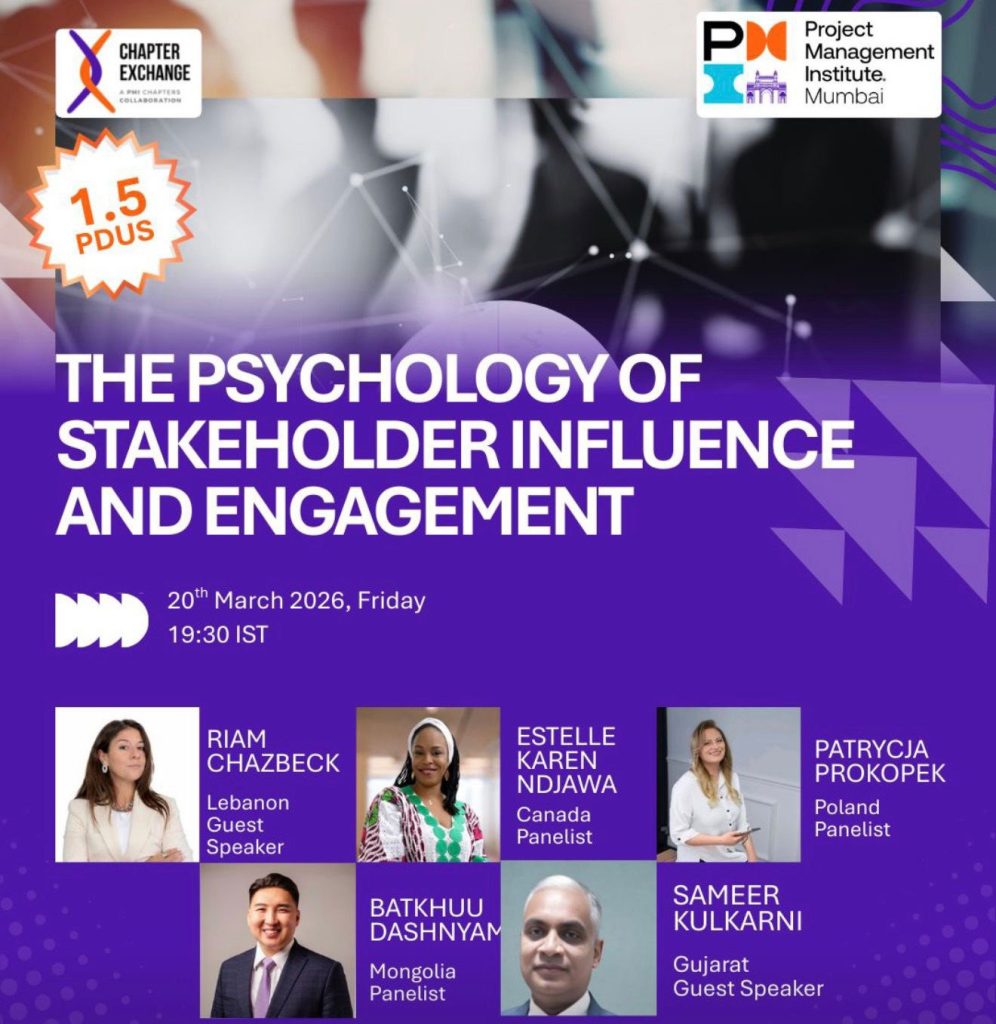
On March 20, 2026, the PMI Mumbai Chapter hosted a session of its Chapter Exchange program that brought together a diverse panel of global practitioners, with PMI Lebanon Chapter President Riam Chazbeck as a guest speaker, to explore one of the most critical dimensions of project success: the human side of stakeholder engagement.
The panel featured Sameer Kulkarni, Batkhuu Dashnyam, Estelle Karen Ndjawa, Patrycja Prokopek, Ashfaq Ahmed, Tao Chun Liu, Priscila Vendramini Mezzena, and Aneta Wereszczak, each bringing perspectives shaped by international experience. At the heart of the discussion stood a powerful reminder: project management is not only about processes, tools, or timelines. It is fundamentally about people.
Moving Beyond Compliance Toward Alignment
Workplaces often seek compliance through pressure, overlooking the deeper value of alignment built through understanding. Communication tends to focus on being heard rather than truly listening, which leads to resistance, disengagement, and misalignment. When stakeholders feel heard, included, and acknowledged as part of the solution, resistance fades and ownership develops.
Key Insights From the Panel
- From threat to reward: stakeholder behavior is strongly shaped by emotional responses. The SCARF model (Status, Certainty, Autonomy, Relatedness, and Fairness) offers a practical lens to shift interactions from defensive reactions to collaborative engagement.
- Building a circle of safety: consistency and competence are the foundation of trust. In fast-paced, AI-driven environments, psychological safety encourages cooperation rather than competition.
- Co-creation over command: top-down directives often trigger resistance. Co-creation fosters ownership by letting stakeholders contribute meaningfully to solutions.
- The power of framing: how a message is delivered shapes how it is perceived. Strategic framing and early alignment conversations can do more than long presentations or data-heavy discussions.
- Emotional intelligence as a differentiator: technical expertise alone is no longer enough. Emotional intelligence enables deeper connection, stronger collaboration, and sustained engagement.
- The human anchor in project management: project professionals increasingly work where strategy meets psychology. Understanding cognitive biases, such as loss aversion and confirmation bias, supports better decisions and stakeholder alignment.
The T.R.U.S.T. Framework for Stakeholder Engagement
- Trust: maintain consistency and transparency
- Reward: create environments where stakeholders feel safe and valued
- Understand: recognize underlying motivations and biases
- SCARF: address fundamental social needs
- Tailor: adapt communication styles to different audiences
A Call for Authentic Leadership
A recurring theme was the need to move beyond performative leadership. Authentic engagement means recognizing the human dimension in every interaction, with empathy, inclusion, and meaningful dialogue. In a complex, fast-changing professional landscape, sustainable project success depends not only on excellent execution but on the ability to genuinely engage people: successful projects are delivered by understanding and connecting with the people behind the tasks.